> ## Documentation Index
> Fetch the complete documentation index at: https://developer.eka.care/llms.txt
> Use this file to discover all available pages before exploring further.
# Bring Your Own Auth (BYOA)
> Authenticate your own users to EkaCare agents with a short-lived JWT signed by your shared secret (JWE optional)
## Overview
**Bring Your Own Auth (BYOA)** lets you authenticate your own users to EkaCare agents without an OIDC
flow. Your backend builds a short-lived token containing the user's identity, secures it with your
shared secret, and sends it to EkaCare — which looks up your secret by its **Key ID**, verifies the
token, and trusts the claims inside.
BYOA supports two token formats:
* **Signed JWT (JWS)** — **the default**. The claims are signed (HS256) with your shared secret. The
payload is readable but tamper-proof. Lighter and simpler — use this unless you have a specific
reason not to.
* **Encrypted JWE** — an optional, heavier alternative where the claims are *encrypted*. Use it only
when the token travels somewhere it could be logged or inspected (e.g. a URL query parameter) **and**
carries genuinely sensitive data. See [Encrypted Token (JWE)](#encrypted-token-jwe).
Both formats use the **same shared secret and Key ID** from the same BYOA credential. The `kid` header
tells EkaCare which secret to use; the token format (signed vs encrypted) is detected automatically.
**Use BYOA when** your client has no OIDC/OAuth flow and you want to pass user data (mobile, name, etc.)
to EkaCare from your own backend.
***
## JWT or JWE?
**Default to a signed JWT.** Reach for JWE only when **both** of these are true:
1. The token is sent somewhere observable — most commonly a **URL query parameter** (which can be
logged by proxies, servers, and browser history), rather than a header or request body, **and**
2. The payload contains **highly sensitive information** that must not be readable in transit.
If you're passing the token in a header, request body, or the widget's `auth-token` attribute — which
is the normal case — **use a JWT**. It's lighter, easier to debug, and just as secure against
tampering.
| | Signed JWT (JWS) — default | Encrypted JWE |
| - | - | - |
| Claims visibility | Readable (base64), signed | Encrypted |
| Weight / complexity | Lighter, simpler | Heavier |
| Tamper protection | Yes | Yes |
| When to use | Almost always | Sensitive data on query params |
***
## Before You Begin
Create a BYOA credential in the [Eka Developer Console](https://console.eka.care). You will need:
* **Key ID** — the public identifier for your credential (e.g. `byoa_xxxxxxxxxxxxxxxx`); goes in the
token's `kid` header.
* **Shared secret** — used to sign (JWT) or encrypt (JWE) the token. Shown only once at creation.
* **Issuer** — the issuer URL you registered on the credential; the token's `iss` claim must match it
exactly.
The shared secret is shown only once. Store it securely on your backend and never expose it in
client-side code. If it is lost or leaked, revoke the credential and create a new one.
***
## How It Works
In the [Eka Developer Console](https://console.eka.care) (BYOA → Create) you get a **Key ID** and a
**shared secret**. The secret is shown only once — copy it immediately.
On your backend, assemble the user's identity claims (see [Token Structure](#token-structure)).
Sign the claims with your shared secret using **HS256**, with the protected header `kid` set to your
Key ID. (Or, for the sensitive-query-param case, [encrypt as a JWE](#encrypted-token-jwe).)
Hand the token to your embedded MedAssist widget — via the `auth-token` attribute or
`EkaMedAssist.init({ authToken })`. See [Send the Token](#send-the-token).
EkaCare looks up your secret and registered issuer by the `kid`, verifies the signature, and trusts
the verified claims.
***
## Token Structure
The `x-auth-token` is a compact **JWT** (JWS) with a signed header and a payload of claims.
### Header
```json theme={null}
{ "kid": "byoa_xxxxxxxxxxxxxxxx", "alg": "HS256", "typ": "JWT" }
```
* `kid` — your credential's Key ID.
* `alg` — `HS256` (HMAC-SHA256; the shared secret is the signing key).
* `typ` — `JWT`.
### Payload claims
Your issuer — must exactly match the issuer registered on your credential.
Intended audience. Always `https://eka.care`.
Subject — your stable user identifier (partner user id). Leave it empty (`""`) if you identify users
only by mobile number (e.g. WhatsApp), where the `mobile` claim is the identifier instead.
The user's mobile number, with country code.
Issued-at time, in epoch seconds (UTC).
Expiry time, in epoch seconds. Keep it short — `iat + 300` (about 5 minutes).
Recommended. A unique ID per request so EkaCare can reject replays of the same token.
Example payload:
```json theme={null}
{
"iss": "https://partner.example.com",
"aud": "https://eka.care",
"sub": "partner_user_12345",
"mobile": "+919876543210",
"iat": 1749600000,
"exp": 1749600300,
"jti": "b3f1c2a4-9e5d-4c8b-a1f2-0d7e6c5b4a39"
}
```
The shared secret is a base64url-encoded 32-byte key. Decode it to 32 raw bytes before using it as the
HS256 HMAC signing key.
***
## Generate the Token
Build the claims and sign them as a JWT with your shared secret (`HS256`, header `kid`). The shared
secret is base64url-decoded to a 32-byte key.
```python Python theme={null}
import base64
import time
import uuid
import jwt # PyJWT
def mint_partner_token() -> str:
# Provided by Eka
kid = "byoa_xxxxxxxxxxxxxxxx"
secret = "dGVzdHNlY3JldGtleWZvcmp3ZXRlc3QxMjM0NTY3ODk"
# base64url-decode the secret to 32 raw bytes (the HMAC key)
raw = base64.urlsafe_b64decode(secret + "==")
# Your values
now = int(time.time())
claims = {
"iss": "https://partner.example.com",
"aud": "https://eka.care",
"sub": "partner_user_12345", # leave "" if you only have mobile
"mobile": "+919876543210",
"iat": now,
"exp": now + 300,
"jti": str(uuid.uuid4()),
}
return jwt.encode(claims, raw, algorithm="HS256", headers={"kid": kid})
token = mint_partner_token()
print(token)
```
```javascript Node.js theme={null}
import { SignJWT } from 'jose';
import { randomUUID } from 'crypto';
async function mintPartnerToken() {
const kid = "byoa_xxxxxxxxxxxxxxxx";
const secret = "dGVzdHNlY3JldGtleWZvcmp3ZXRlc3QxMjM0NTY3ODk";
// base64url-decode the secret to 32 raw bytes (the HMAC key)
const key = Buffer.from(secret, "base64url");
const now = Math.floor(Date.now() / 1000);
return await new SignJWT({
sub: "partner_user_12345", // leave "" if you only have mobile
mobile: "+919876543210",
})
.setProtectedHeader({ alg: "HS256", kid })
.setIssuer("https://partner.example.com")
.setAudience("https://eka.care")
.setIssuedAt(now)
.setExpirationTime(now + 300)
.setJti(randomUUID())
.sign(key);
}
mintPartnerToken()
.then(token => {
console.log("\nGenerated JWT:\n");
console.log(token);
})
.catch(console.error);
```
```go Go theme={null}
package main
import (
"encoding/base64"
"fmt"
"time"
"github.com/golang-jwt/jwt/v5"
"github.com/google/uuid"
)
func mintPartnerToken() (string, error) {
kid := "byoa_xxxxxxxxxxxxxxxx"
secret := "dGVzdHNlY3JldGtleWZvcmp3ZXRlc3QxMjM0NTY3ODk"
// base64url-decode the secret to 32 raw bytes (the HMAC key)
key, err := base64.RawURLEncoding.DecodeString(secret)
if err != nil {
return "", err
}
now := time.Now().Unix()
claims := jwt.MapClaims{
"iss": "https://partner.example.com",
"aud": "https://eka.care",
"sub": "partner_user_12345", // leave "" if you only have mobile
"mobile": "+919876543210",
"iat": now,
"exp": now + 300,
"jti": uuid.NewString(),
}
token := jwt.NewWithClaims(jwt.SigningMethodHS256, claims)
token.Header["kid"] = kid
return token.SignedString(key)
}
func main() {
token, err := mintPartnerToken()
if err != nil {
panic(err)
}
fmt.Println(token)
}
```
```java Java theme={null}
import org.jose4j.jws.JsonWebSignature;
import org.jose4j.jws.AlgorithmIdentifiers;
import org.jose4j.jwt.JwtClaims;
import org.jose4j.keys.HmacKey;
import java.util.Base64;
public class GenerateJWT {
public static void main(String[] args) throws Exception {
String kid = "byoa_xxxxxxxxxxxxxxxx";
String secret = "dGVzdHNlY3JldGtleWZvcmp3ZXRlc3QxMjM0NTY3ODk";
// base64url-decode the secret to 32 raw bytes (the HMAC key)
byte[] keyBytes = Base64.getUrlDecoder().decode(secret);
JwtClaims claims = new JwtClaims();
claims.setIssuer("https://partner.example.com");
claims.setAudience("https://eka.care");
claims.setSubject("partner_user_12345"); // leave "" if you only have mobile
claims.setClaim("mobile", "+919876543210");
claims.setIssuedAtToNow();
claims.setExpirationTimeMinutesInTheFuture(5);
claims.setGeneratedJwtId();
JsonWebSignature jws = new JsonWebSignature();
jws.setPayload(claims.toJson());
jws.setKey(new HmacKey(keyBytes));
jws.setAlgorithmHeaderValue(AlgorithmIdentifiers.HMAC_SHA256);
jws.setKeyIdHeaderValue(kid);
System.out.println(jws.getCompactSerialization());
}
}
```
***
## Send the Token
The **MedAssist widget** is EkaCare's embeddable chat widget. Copy its embed snippet from your agent's
**Widget** tab in the [Developer Console](https://console.eka.care) (or see the
[widget quickstart](/ai-tools/synapse/embed/quickstart)), then add the token to it.
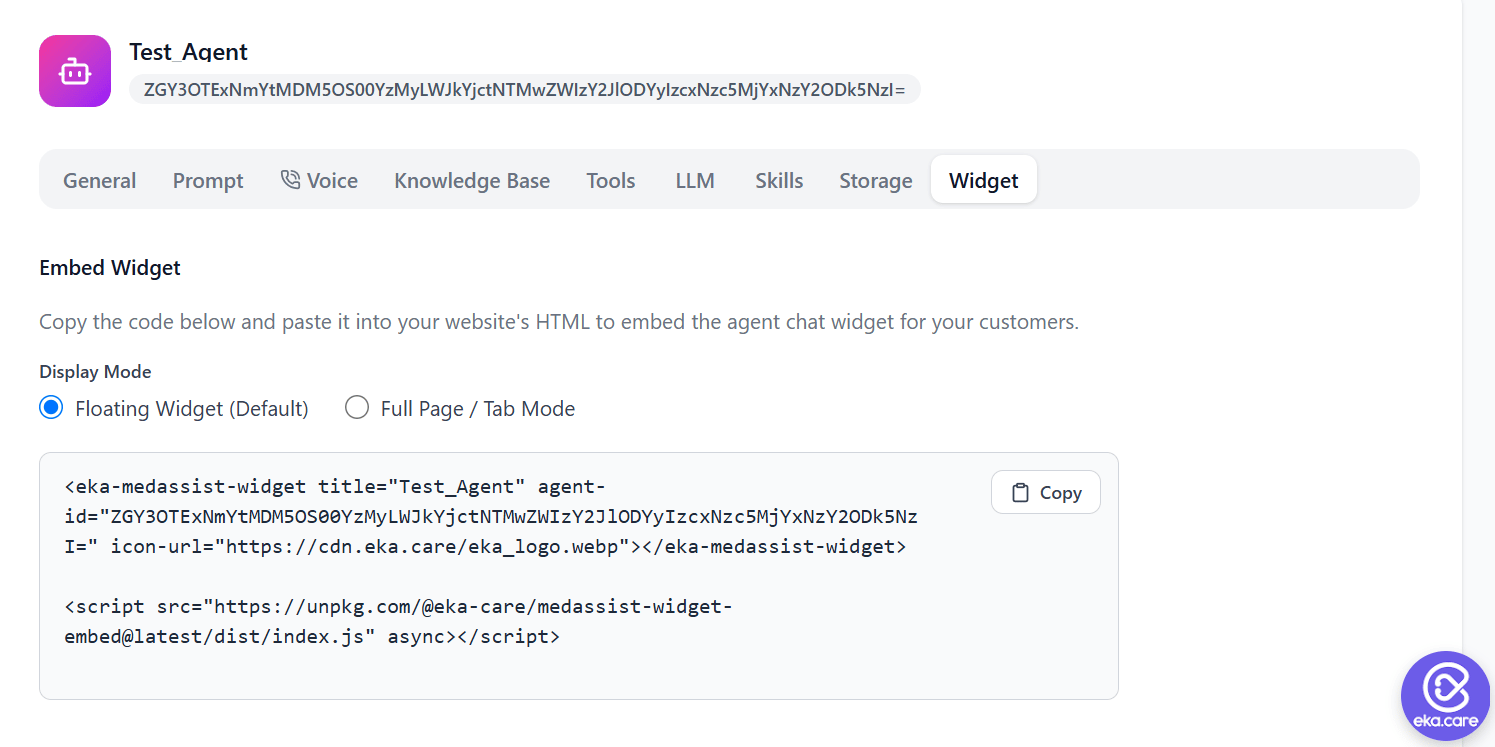 There are two ways to pass the token:
```html Custom element theme={null}
```
```html JavaScript theme={null}
```
* **Custom element** — set the `auth-token` attribute on the `` element. Best
when you can render the token into the page server-side. See the
[widget quickstart](/ai-tools/synapse/embed/quickstart).
* **JavaScript** — pass `authToken` to `EkaMedAssist.init()`. Best when the token is dynamic (e.g.
minted per logged-in user at runtime). See the
[JavaScript API](/ai-tools/synapse/embed/javascript-api).
***
## How EkaCare Verifies
When EkaCare receives the token, it:
1. Reads the `kid` from the token header and looks up the matching **shared secret** and registered
**issuer**.
2. Verifies the JWT signature with your secret (or decrypts it, if it's a JWE).
3. Verifies the claims — `iss` matches the registered issuer, `aud` is `https://eka.care`, and `iat`
and `exp` are within the allowed window. If you include a `jti`, it must not have been seen before
(replay protection).
If any check fails, the request is rejected.
***
## Encrypted Token (JWE)
JWE is an **optional alternative to the default signed JWT**. It's heavier than a JWT. Only use it when
the token is sent somewhere observable — most commonly a **URL query parameter** (which can be logged
by proxies, servers, and browser history) — **and** its payload holds highly sensitive information that
must not be readable in transit. Otherwise, use a [signed JWT](#generate-the-token).
A JWE carries the **same claims** as the JWT above ([Token Structure](#token-structure)) and uses the
**same Key ID and shared secret** — the payload is *encrypted* instead of signed.
### Header
```json theme={null}
{ "kid": "byoa_xxxxxxxxxxxxxxxx", "alg": "dir", "enc": "A256GCM" }
```
* `kid` — your credential's Key ID.
* `alg` — `dir` (the shared secret is used directly as the encryption key).
* `enc` — `A256GCM` (content encryption).
The shared secret is a base64url-encoded 32-byte key. Decode it to 32 raw bytes before using it as the
`A256GCM` content-encryption key.
### Generate the JWE
Build the claims, encrypt them as a JWE with your shared secret (`alg: dir`, `enc: A256GCM`, header
`kid`), and serialize to compact form. The shared secret is base64url-decoded to a 32-byte key.
```python Python theme={null}
import base64
import time
import orjson
from jwcrypto import jwe, jwk
def mint_partner_token() -> str:
# Provided by Eka
kid = "byoa_xxxxxxxxxxxxxxxx"
secret = "dGVzdHNlY3JldGtleWZvcmp3ZXRlc3QxMjM0NTY3ODk"
# Your values
now = int(time.time())
claims = {
"iss": "https://partner.example.com",
"aud": "https://eka.care",
"sub": "partner_user_12345",
"mobile": "+919876543210",
"iat": now,
"exp": now + 300,
}
# Build key
padded = secret + "=" * (-len(secret) % 4)
raw = base64.urlsafe_b64decode(padded)
k_b64 = base64.urlsafe_b64encode(raw).rstrip(b"=").decode()
jwk_key = jwk.JWK(kty="oct", k=k_b64)
# Encrypt
token_obj = jwe.JWE(
plaintext=orjson.dumps(claims),
protected=orjson.dumps({"alg": "dir", "enc": "A256GCM", "kid": kid}).decode(),
)
token_obj.add_recipient(jwk_key)
return token_obj.serialize(compact=True)
token = mint_partner_token()
print(token)
```
```javascript Node.js theme={null}
import { CompactEncrypt } from 'jose';
async function mintPartnerToken() {
const kid = "byoa_xxxxxxxxxxxxxxxx";
const secret = "dGVzdHNlY3JldGtleWZvcmp3ZXRlc3QxMjM0NTY3ODk";
const now = Math.floor(Date.now() / 1000);
const claims = {
iss: "https://partner.example.com",
aud: "https://eka.care",
sub: "partner_user_12345",
mobile: "+919876543210",
iat: now,
exp: now + 300,
};
const key = Buffer.from(secret, "base64url");
const token = await new CompactEncrypt(
Buffer.from(JSON.stringify(claims))
)
.setProtectedHeader({
alg: "dir",
enc: "A256GCM",
kid,
})
.encrypt(key);
return token;
}
mintPartnerToken()
.then(token => {
console.log("\nGenerated JWE:\n");
console.log(token);
})
.catch(console.error);
```
```go Go theme={null}
package main
import (
"encoding/base64"
"encoding/json"
"fmt"
"time"
jose "github.com/go-jose/go-jose/v4"
)
func mintPartnerToken() (string, error) {
kid := "byoa_xxxxxxxxxxxxxxxx"
secret := "dGVzdHNlY3JldGtleWZvcmp3ZXRlc3QxMjM0NTY3ODk"
now := time.Now().Unix()
claims := map[string]interface{}{
"iss": "https://partner.example.com",
"aud": "https://eka.care",
"sub": "partner_user_12345",
"mobile": "+919876543210",
"iat": now,
"exp": now + 300,
}
payload, err := json.Marshal(claims)
if err != nil {
return "", err
}
key, err := base64.RawURLEncoding.DecodeString(secret)
if err != nil {
return "", err
}
encrypter, err := jose.NewEncrypter(
jose.A256GCM,
jose.Recipient{
Algorithm: jose.DIRECT,
Key: key,
},
(&jose.EncrypterOptions{}).WithHeader("kid", kid),
)
if err != nil {
return "", err
}
obj, err := encrypter.Encrypt(payload)
if err != nil {
return "", err
}
return obj.CompactSerialize()
}
func main() {
token, err := mintPartnerToken()
if err != nil {
panic(err)
}
fmt.Println(token)
}
```
```java Java theme={null}
import org.jose4j.jwe.JsonWebEncryption;
import org.jose4j.jwe.ContentEncryptionAlgorithmIdentifiers;
import org.jose4j.jwe.KeyManagementAlgorithmIdentifiers;
import org.jose4j.keys.AesKey;
import java.util.Base64;
public class GenerateJWE {
public static void main(String[] args) throws Exception {
String kid = "byoa_xxxxxxxxxxxxxxxx";
String secret = "dGVzdHNlY3JldGtleWZvcmp3ZXRlc3QxMjM0NTY3ODk";
long now = System.currentTimeMillis() / 1000;
String payload = String.format("""
{
"iss":"https://partner.example.com",
"aud":"https://eka.care",
"sub":"partner_user_12345",
"mobile":"+919876543210",
"iat":%d,
"exp":%d
}
""", now, now + 300);
byte[] keyBytes = Base64.getUrlDecoder().decode(secret);
AesKey key = new AesKey(keyBytes);
JsonWebEncryption jwe = new JsonWebEncryption();
jwe.setPayload(payload);
jwe.setAlgorithmHeaderValue(
KeyManagementAlgorithmIdentifiers.DIRECT);
jwe.setEncryptionMethodHeaderParameter(
ContentEncryptionAlgorithmIdentifiers.AES_256_GCM);
jwe.setKeyIdHeaderValue(kid);
jwe.setKey(key);
String token = jwe.getCompactSerialization();
System.out.println(token);
}
}
```
EkaCare detects the JWE format automatically, looks up your secret by `kid`, decrypts it, and verifies
the same claims as a JWT.
***
## Best Practices
* Generate tokens **server-side only** — never ship the shared secret to a browser or mobile app.
* Prefer a **signed JWT**; reach for JWE only for sensitive data on query parameters.
* Keep `exp` short (\~5 minutes) and use a fresh `jti` for every request.
* Rotate by revoking the credential and creating a new one, then update your agents to the new Key ID.
This documentation is built and hosted on [Mintlify](https://mintlify.com), a developer documentation platform.
There are two ways to pass the token:
```html Custom element theme={null}
```
```html JavaScript theme={null}
```
* **Custom element** — set the `auth-token` attribute on the `` element. Best
when you can render the token into the page server-side. See the
[widget quickstart](/ai-tools/synapse/embed/quickstart).
* **JavaScript** — pass `authToken` to `EkaMedAssist.init()`. Best when the token is dynamic (e.g.
minted per logged-in user at runtime). See the
[JavaScript API](/ai-tools/synapse/embed/javascript-api).
***
## How EkaCare Verifies
When EkaCare receives the token, it:
1. Reads the `kid` from the token header and looks up the matching **shared secret** and registered
**issuer**.
2. Verifies the JWT signature with your secret (or decrypts it, if it's a JWE).
3. Verifies the claims — `iss` matches the registered issuer, `aud` is `https://eka.care`, and `iat`
and `exp` are within the allowed window. If you include a `jti`, it must not have been seen before
(replay protection).
If any check fails, the request is rejected.
***
## Encrypted Token (JWE)
JWE is an **optional alternative to the default signed JWT**. It's heavier than a JWT. Only use it when
the token is sent somewhere observable — most commonly a **URL query parameter** (which can be logged
by proxies, servers, and browser history) — **and** its payload holds highly sensitive information that
must not be readable in transit. Otherwise, use a [signed JWT](#generate-the-token).
A JWE carries the **same claims** as the JWT above ([Token Structure](#token-structure)) and uses the
**same Key ID and shared secret** — the payload is *encrypted* instead of signed.
### Header
```json theme={null}
{ "kid": "byoa_xxxxxxxxxxxxxxxx", "alg": "dir", "enc": "A256GCM" }
```
* `kid` — your credential's Key ID.
* `alg` — `dir` (the shared secret is used directly as the encryption key).
* `enc` — `A256GCM` (content encryption).
The shared secret is a base64url-encoded 32-byte key. Decode it to 32 raw bytes before using it as the
`A256GCM` content-encryption key.
### Generate the JWE
Build the claims, encrypt them as a JWE with your shared secret (`alg: dir`, `enc: A256GCM`, header
`kid`), and serialize to compact form. The shared secret is base64url-decoded to a 32-byte key.
```python Python theme={null}
import base64
import time
import orjson
from jwcrypto import jwe, jwk
def mint_partner_token() -> str:
# Provided by Eka
kid = "byoa_xxxxxxxxxxxxxxxx"
secret = "dGVzdHNlY3JldGtleWZvcmp3ZXRlc3QxMjM0NTY3ODk"
# Your values
now = int(time.time())
claims = {
"iss": "https://partner.example.com",
"aud": "https://eka.care",
"sub": "partner_user_12345",
"mobile": "+919876543210",
"iat": now,
"exp": now + 300,
}
# Build key
padded = secret + "=" * (-len(secret) % 4)
raw = base64.urlsafe_b64decode(padded)
k_b64 = base64.urlsafe_b64encode(raw).rstrip(b"=").decode()
jwk_key = jwk.JWK(kty="oct", k=k_b64)
# Encrypt
token_obj = jwe.JWE(
plaintext=orjson.dumps(claims),
protected=orjson.dumps({"alg": "dir", "enc": "A256GCM", "kid": kid}).decode(),
)
token_obj.add_recipient(jwk_key)
return token_obj.serialize(compact=True)
token = mint_partner_token()
print(token)
```
```javascript Node.js theme={null}
import { CompactEncrypt } from 'jose';
async function mintPartnerToken() {
const kid = "byoa_xxxxxxxxxxxxxxxx";
const secret = "dGVzdHNlY3JldGtleWZvcmp3ZXRlc3QxMjM0NTY3ODk";
const now = Math.floor(Date.now() / 1000);
const claims = {
iss: "https://partner.example.com",
aud: "https://eka.care",
sub: "partner_user_12345",
mobile: "+919876543210",
iat: now,
exp: now + 300,
};
const key = Buffer.from(secret, "base64url");
const token = await new CompactEncrypt(
Buffer.from(JSON.stringify(claims))
)
.setProtectedHeader({
alg: "dir",
enc: "A256GCM",
kid,
})
.encrypt(key);
return token;
}
mintPartnerToken()
.then(token => {
console.log("\nGenerated JWE:\n");
console.log(token);
})
.catch(console.error);
```
```go Go theme={null}
package main
import (
"encoding/base64"
"encoding/json"
"fmt"
"time"
jose "github.com/go-jose/go-jose/v4"
)
func mintPartnerToken() (string, error) {
kid := "byoa_xxxxxxxxxxxxxxxx"
secret := "dGVzdHNlY3JldGtleWZvcmp3ZXRlc3QxMjM0NTY3ODk"
now := time.Now().Unix()
claims := map[string]interface{}{
"iss": "https://partner.example.com",
"aud": "https://eka.care",
"sub": "partner_user_12345",
"mobile": "+919876543210",
"iat": now,
"exp": now + 300,
}
payload, err := json.Marshal(claims)
if err != nil {
return "", err
}
key, err := base64.RawURLEncoding.DecodeString(secret)
if err != nil {
return "", err
}
encrypter, err := jose.NewEncrypter(
jose.A256GCM,
jose.Recipient{
Algorithm: jose.DIRECT,
Key: key,
},
(&jose.EncrypterOptions{}).WithHeader("kid", kid),
)
if err != nil {
return "", err
}
obj, err := encrypter.Encrypt(payload)
if err != nil {
return "", err
}
return obj.CompactSerialize()
}
func main() {
token, err := mintPartnerToken()
if err != nil {
panic(err)
}
fmt.Println(token)
}
```
```java Java theme={null}
import org.jose4j.jwe.JsonWebEncryption;
import org.jose4j.jwe.ContentEncryptionAlgorithmIdentifiers;
import org.jose4j.jwe.KeyManagementAlgorithmIdentifiers;
import org.jose4j.keys.AesKey;
import java.util.Base64;
public class GenerateJWE {
public static void main(String[] args) throws Exception {
String kid = "byoa_xxxxxxxxxxxxxxxx";
String secret = "dGVzdHNlY3JldGtleWZvcmp3ZXRlc3QxMjM0NTY3ODk";
long now = System.currentTimeMillis() / 1000;
String payload = String.format("""
{
"iss":"https://partner.example.com",
"aud":"https://eka.care",
"sub":"partner_user_12345",
"mobile":"+919876543210",
"iat":%d,
"exp":%d
}
""", now, now + 300);
byte[] keyBytes = Base64.getUrlDecoder().decode(secret);
AesKey key = new AesKey(keyBytes);
JsonWebEncryption jwe = new JsonWebEncryption();
jwe.setPayload(payload);
jwe.setAlgorithmHeaderValue(
KeyManagementAlgorithmIdentifiers.DIRECT);
jwe.setEncryptionMethodHeaderParameter(
ContentEncryptionAlgorithmIdentifiers.AES_256_GCM);
jwe.setKeyIdHeaderValue(kid);
jwe.setKey(key);
String token = jwe.getCompactSerialization();
System.out.println(token);
}
}
```
EkaCare detects the JWE format automatically, looks up your secret by `kid`, decrypts it, and verifies
the same claims as a JWT.
***
## Best Practices
* Generate tokens **server-side only** — never ship the shared secret to a browser or mobile app.
* Prefer a **signed JWT**; reach for JWE only for sensitive data on query parameters.
* Keep `exp` short (\~5 minutes) and use a fresh `jti` for every request.
* Rotate by revoking the credential and creating a new one, then update your agents to the new Key ID.
This documentation is built and hosted on [Mintlify](https://mintlify.com), a developer documentation platform.